
When it comes to video games, Ancient Greek mythology is the gift that keeps on giving. Hades, Assassin’s Creed, God of War, Age of Mythology, Asterigos: Curse of the Stars; long is the list of games directly inspired by stories that were told between the denizens of a sporadic selection of city-states over two thousand years ago. Another game that utilised the myths and legends of ancient Greece for some deeply effectively world-building was the cult classic action RPG, Titan Quest. With its long-awaited sequel, Titan Quest 2, now available in early access, it seemed we recently checked in with Lead Narrative Designer, Matthew Cropley, and discover how Greek mythology has informed that game’s development.
First up, I wanted to know, what historical research – or mythological research, I guess – had Matthew and the team conducted during development? Matthew immediately impressed with his hardcore history nerd credentials:
“I’m someone who has had a passion for mythology, particularly Greek mythology, for my entire life, so my approach when joining the Titan Quest 2 team was to dive in deep based on what I already knew. A lot of the time, when conceiving of a quest or a piece of lore, we’ll start off with a basic idea and then do a research deep-dive to explore it and see if it fits with what sort of quest we were hoping to do, and if it sparks any further ideas.”
Alright Matthew, sounds promising, now give me all the juicy research details!
“Soon after starting on the project I read Emily Wilson’s translation of The Odyssey and found it delightful. She’s written it in clear, modern English that makes the story quite approachable and entertaining. Odysseus is a great example of the Greek hero’s mindset and how it differs from our conception of modern heroes (e.g. glory over morality). Her introductory essay and translator’s note were also wonderful resources about both that story and Greek myth in general. Stephen Fry’s Mythos was another great book that attempts to bring a lot of disparate myths together into a semi-coherent timeline, and it’s a wonderful overview of things. His characterizations of the gods are a delight to read. Beyond that, just engaging with as much Greek Mythology-inspired content as possible, like Ray Harryhausen’s old movies, has been important.”

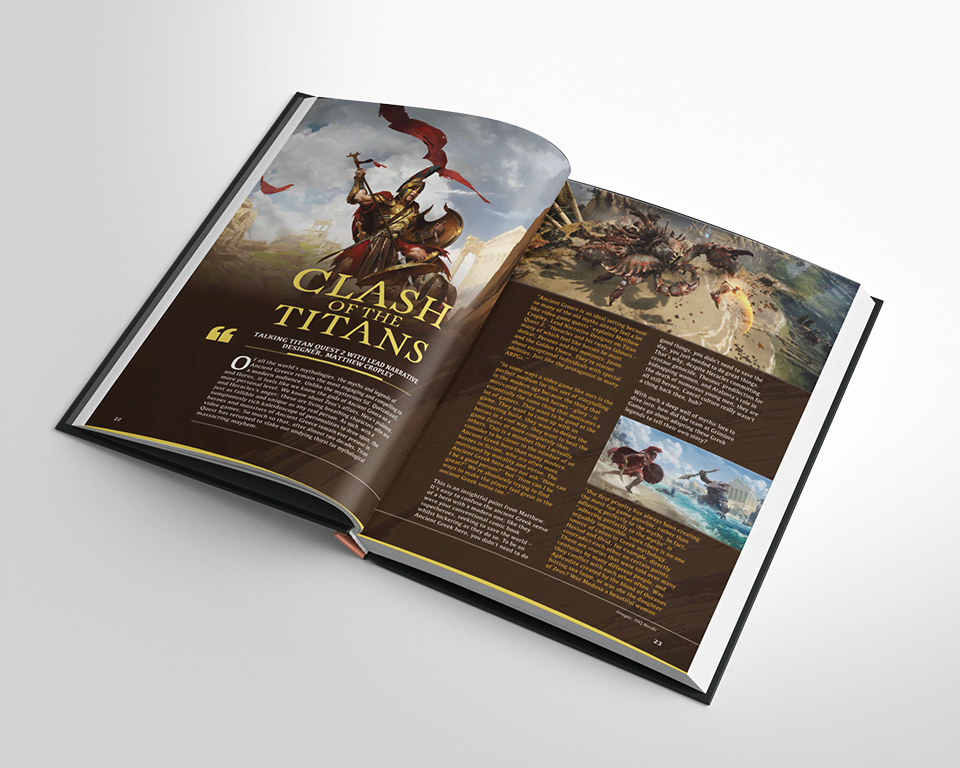
Playing With History is an upcoming book that bridges the gap between video games and the real-world historical people and events that inspired them.
These answers got me pondering, possibly even pontificating, on what to ask Matthew next. As I sat, glassy eyed, starring into the middle distance, my mind whirring, Matthew clearly got a little uncomfortable so started telling me stuff about which particular Greek myths had inspired the development of Titan Quest 2.
“The first starting point for inspiration were the stories of great heroes, such as Herakles, Jason, Perseus, Bellerophon and Odysseus. Since we wanted the player to feel like a hero, figuring out what made Ancient Greek heroes tick was an important starting point. We tried to give the player a “moral” way of framing their actions, but we’ve also tried to give some more “Ancient Greek-style” framings, by letting the player be boisterous, glory-seeking and competitive. Taking key “epic” moments from the stories of heroes and giving the player opportunity to live out similar moments is really important. There are epic creatures to slay, magical artifacts to find, and deeply personal connections to gods and monsters to grapple with.”
Aha! I had recovered from my prolonged period of thinking and had come up with another question. Talking of monsters to slay, Greek heroes were well known for their delight in chopping up hideous creatures that were formed of a multitude of animal parts. Were there any particular evil beasties that Matthew enjoyed adapting for the game?

“Two monsters come to mind.” Matthew mused, “Firstly, Skylla, who is a nymph that was transformed into a sea monster by the gods. She’s a scary presence in The Odyssey, but I really enjoyed digging into the myth and exploring who Skylla was as a nymph before her transformation, which isn’t an angle that’s been explored much. I have also particularly enjoyed creating our version of a siren. In modern media, sirens are usually depicted as very mermaid-like, but in the original myths they’re actually described as bird-like. Our Art team did a great job with the visuals of our version. Writing her dialogue was a treat. But of course, the most important aspect of sirens is their song, and working with the sound people to build a quest around a siren’s song that we get to see/hear performed on-screen is really something special and I think it came together beautifully.”
Though, in order to battle Skylla and a flock of Sirens, the player is going to need an armoury of exotic weaponry. The original Titan Quest was held in high regard for its tremendous amount of gear and the number of powerful abilities for players to choose from – so how have the original Greek myths informed these deadly creations for the sequel?
“There’s just a wonderfully natural synergy between Greek myths and ARPGS.” confirms Matthew. “The myths are absolutely filled with epic weapons, abilities, armour and tools, wielded by both mortals and gods.”

“Herakles has his super-strength as a defining trait. Perseus has his magical tools, gifted by gods. Zeus’s lightning bolt and Poseidon’s trident are two of the most iconic divine weapons in all of myth, crafted by the original Cyclopes for the war against the Titans. Hades had a helm of invisibility made at the same time. Athena has her aegis, a cloak or shield that protects her from any harm. Hermes has his winged sandals. There are many, many more. What is fun about all of these things is that they all have such a clear flavour and epic feel, which is something the Systems Designers and Artists have done a really good job of reflecting in the game’s itemization. It’s also important, however, that players don’t start the game with any abilities or items that are too powerful. The “zero to hero” journey is important here, and earning epic items and abilities should feel like significant moments in the game, as it does in the myths.”
To round out the interview, we asked Matthew how Titan Quest II expands on the mythological elements of the original game?
“Depth. The original game did a great job of making you feel like you’re an Ancient Greek hero on a quest, but due to the nature of that game, there wasn’t as much opportunity to really get to know the mythological characters and situations as much as we have in TQ2. Almost twenty years later, we have the advantage of updated technology, art, and designs that we can use to immerse players (hopefully) even more into the core fantasy of the original game.”
Titan Quest II is out now and available to play on PlayStation 5, Xbox Series X|S, and PC. In the meantime, why not check out our upcoming Playing With History book? Featuring over 100 games, 200 pages, and thousands of years of human history, it was successfully funded on Kickstarter in 2025 and will be launching in the coming months.