
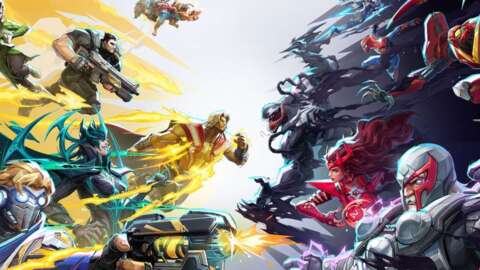


Marvel Rivals released in December 2024, making 2025 the first full calendar year of Marvel Rivals as a live-service multiplayer shooter. In the first year, NetEase, the developer of Marvel Rivals, has shown itself more than ready to handle a live-service game, even if it doesn’t always get it right the first time. Not only did it sustain the promised one hero per month cadence, but NetEase has been fairly reactive to fan complaints.
Skins have been tweaked, special event modes like Marvel Zombies were extended at fan request, and just recently Deadpool’s VFX visual clutter and his banter were toned down shortly after his release due to issues. When it comes to the new characters, 12 total across all three classes, the variety of characters has been strong, but there are a few gaps in the roster that need to be addressed.
Right: A Wide Variety of Dive and Brawl Vanguards

Marvel Rivals added four new Vanguards, the tank class that’s focused on controlling the pace of battle: The Thing, Emma Frost, Angela, and Rogue. While you can argue the minor differences between Dive and Brawl–Dive is more about pushing deep into your opponent’s territory, while Brawl characters try to be a nuisance in the middle of the fight–all of these tanks share similar playstyles.
Rivals had a couple dive tanks at launch, with Thor and Venom being the primary examples, but the additions have expanded the diversity in gameplay and tool kits in a great way. As someone who loves playing more aggressive tanks in these hero shooters, I’ve been quite happy to have Emma Frost and Rogue in Marvel Rivals, and having more variety encourages more people to play Vanguard, something that has been a struggle lately.
Wrong: A Lack of Shield Vanguards

Vanguard appears to be the least popular role among players, and a likely part of the reason is that there hasn’t been a new shield tank–focused on defense and high damage resistance, usually with a shield ability–since launch. Emma Frost does technically have a shield, but for this conversation, we’re talking about Vanguard characters who use their shields to control the pace of combat and defend their teammates. The only real shield options in Marvel Rivals are Magneto, Dr. Strange, and Groot, with that last one being a bit of a stretch.
The lack of shield Vanguards has meant that both Dr. Strange and Magneto have been able to maintain a strong presence in the meta throughout 2025 after being underpowered at launch, but a new shield Vanguard could encourage more people to play the role. At least, new characters would give the dedicated shield tank players another option. Season 6’s Deadpool has a Vanguard kit that also doesn’t include a shield, and Elsa Bloodstone seems unlikely to be a tank, making Season 7 the earliest we could get a new shield tank–although I’m not holding my breath.
Right: A Better Mix of Strategist Ultimates

One of the primary issues plaguing the Strategist, healing and support, role in Marvel Rivals at launch was a lack of diversity in Strategist ultimate abilities, which often boiled down to “large area of healing that makes it impossible to kill anyone.” Luna Snow, Cloak and Dagger, Mantis, and Invisible Woman all have a functionally similar ultimate ability. Considering that three of those heroes are some of the most popular picks right now, it really starts to feel like the entire game is built around those types of ultimates.
Luckily, our new Strategists–specifically Ultron and Gambit–have different abilities. Sure, both of them amount to a large amount of healing, but since Ultron’s ultimate is a buff to his primary fire and Gambit’s ultimate provides a buff to his teammates, the characters feel different in match, which provides some much needed variety.
Wrong: The Competitive Ban System

The ban system in Marvel Rivals competitive mode, which allows each team to “ban” two characters at the start of a round so no one can play them, is bad. There are two big frustration points. The first is that both teams can ban the same character in a round. I do like that the bans are done at the same time instead of going back and forth, but it can be frustrating to only have two characters banned in a round.
The other issue compounds with the first, which is the random selection of the banned character. Each team member can select the character they want banned, but it’s not a voting system. Instead, there is a one-in-six chance your ban is chosen, with the odds improving if multiple people pick the same hero. I’ve had plenty of competitive matches where a single person votes for a ban that ultimately gets picked, just to be the exact same ban as the other team.
Right: Even More X-Men

Twelve new heroes were added in 2025, including the Fantastic Four and four X-Men with the remainder not fitting into a clean category. Considering the lack of X-Men in video games prior to recent games like Marvel’s Midnight Suns, it’s nice to see the roster continue to expand with some of the most popular heroes in the Marvel stable that haven’t gotten enough love.
It helps that there are a ton of X-Men to choose from, but the choices for new X-Men have all felt pretty inspired. Going with Phoenix, Emma Frost, Gambit, and Rogue gives a nice mix of heroes. Hopefully this trend continues in 2026, and it seems like it might, with Cyclops teased in the Season 5 story.
Wrong: Power Creep is Already Happening

With the addition of new characters to any type of multiplayer game, “power creep” is often a problem. Developers want to make new characters interesting for players to keep them engaged and viable to play with the existing roster, and the result is often that new characters see significant advantages over old ones. Sometimes this takes the form of a character simply being overpowered at launch, but that can be fixed with balance patches and updates.
The type of power creep that is tougher to solve is “ability creep.” This happens in other, similar games, such as Overwatch 2 or League of Legends, where newer heroes often have larger, more complex movesets, making them inherently stronger compared to launch heroes that have fewer. While most of the new heroes have more abilities than the older ones, a few, like Gambit, Rogue, and Daredevil, all have upwards of six abilities at their disposal, which can make it tough for older characters like Ironman, who really only has three abilities, to compete. Without alterations to how old characters work or how new characters are designed, it’s easy to see a situation in which Marvel Rivals is perpetually adding new, powerful characters that make the old ones obsolete, creating a growing list of useless heroes. The fact that it’s already begun in the first year, and considering how many abilities Deadpool has, is alarming for what future heroes might look like.
Marvel Rivals in 2026

Marvel Rivals has already come out of the game swinging with Season 6, which has added Deadpool as the first hero that can be played as any of the three roles, with Elsa Bloodstone coming with the Season 6.5 update.
If NetEase can continue to bring a variety of Marvel characters, both fan favorites and deep cuts, while also filling in some of the gaps, like with a new shield tank, Marvel Rivals should have a strong second year. While I expect more limited-time game modes like Marvel Zombies and special new modes like 18v18, I do think it’s time for a new core game mode to get added to the pool beyond payload and control point. NetEase has kept future plans close to its chest, but based on the mostly successful first year Marvel Rivals looks set up for success.