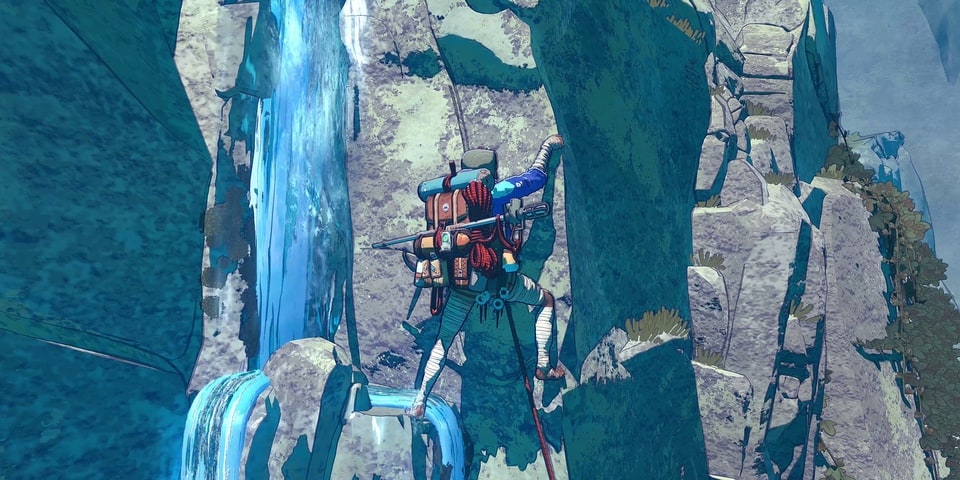

Cairn is a single player, story focused, survival game about climbing a mountain. You won’t be leaping from platform to platform, or swinging round a sledgehammer to propel yourself and your cauldron, though. No, you’ll actually be climbing, moving each of your limbs one at a time to grab handholds and wedge into cracks to scale an entire mountain. It’s not a small one, either, and it’s already populated by the remains of those who have tried and failed to reach the summit before you. It’s a dangerous situation that, somehow, becomes incredibly relaxing and meditative once you get used to it.
Cairn begins, as it must, with a quick tutorial. It’s essential in spite of the fact that you can easily infer the basics. Walk up to a wall, press the button, and you’ll start climbing. From there, it’s “just” a matter of moving your hands and feet, one at a time, to handholds, footholds, crevices, cracks, ledges, and whatever else you can find. Then keep going.
If you were Nathan Drake, you could easily spot a yellow-marked perfect route, scaling the walls like a spider-monkey, but for the more mortal character that you’re playing as, you can expect the camera to zoom in slowly and the edges of the screen darkening as your stamina drops and lactic acid builds up in your muscles. It forces you to quickly adjust to a more tenable position or fall into the abyss. How quickly your stamina drops depends on how good your handhold is, how your body is oriented, how much weight a limb is holding, and so on. You can prop yourself against a smooth wall with one foot if you’ve got a good grip elsewhere, but if you try to scale a completely smooth wall by itself, you’re going to fall almost immediately.

Thankfully there are a few tools to help you avoid the inevitable fall to your death. You have Climbot, a little robot that follows you around, managing your rope and gathering your self-screwing pitons when you finish a climb, and only sometimes getting in the way. Those pitons are pretty handy too, self-screwing into the rock and allowing you to attach a rope, release and recover your stamina. They also means that if you fall, you’ll be hanging from that point and only missing a chunk of health, instead of being impaled on some sharp rocks below. The pitons can break if you mess up the mini-game when placing them, two broken pitons can be recycled into a working piton by Climbot whilst camping.
The Climbot and the pitons are the really important tools, but there’s plenty of other things to think about as well. You also have water, for drinking of course, as well as a tub of chalk. The chalk is useful when you need a bit of extra grip for a riskier climb, granting you enhanced grip with your hands for twelve whole grabs, which can really make the difference. You also have climbing tape, which protects your fingers and improves your grip, and must be replaced regularly or your fingers will become bloody, damaged and worse at gripping rocks.

Of course these things are not unlimited, and this is where the survival elements come in. You’re managing resources, thirst, hunger, and temperature all in addition to actually climbing. The mountain is dotted with resources and you’ll want to find them because starvation, thirst, and hypothermia are just as happy to kill you as gravity is. The climbot can compost items you don’t need into chalk, water can be found in natural pools, falls, and so on, and tape and pitons can be found lying around or on expired climbers. You’ll also find a bunch of food, whether from plants growing or packaged things like coffee, oats, dehydrated soup, just left behind by others.
Most of these can also be processed, cooked, or infused into other things whilst you’re camping. That bag of oats and some sweetened goat milk can be combined into some porridge, you can find some coffee and get yourself a warm drink that gives you energy, or infuse your water bottle with dandelion. All of the food and drink has some effect, whether improving your grip strength, warming you up, or stopping a meter from decreasing for a bit, so they’re really essential even beyond just needing to eat and drink. Cooking ingredients is one of three reasons why you’ll always be looking for the next camping spot as you climb, the others being that resting restores your health, and that they’re also save points.

It seems like a lot to consider, and it is. In fact, I was initially a little overwhelmed by the hunger and thirst bars as I had barely found any food. After a while though, once you’ve got a hang of things and gathered a few things to stave off the hunger, the game becomes incredibly relaxing. Sure, you’re hanging over the edge of a mountain, but it’s a very pretty mountain. In fact, the game is very good looking, with a highly detailed, cel-shaded style. The environment is genuinely stop-for-a-minute-and-gawp gorgeous, though you and the few people you meet through the course of the story all look quite strange to say the least. It’s not just any mountain either, it’s one that was also populated at one point by troglodytes – a word I’ve now discovered means someone who lives in a cave. You’ll find not only notes and background information lying around, but parts of the mountain are carved and styled around where they used to live. It looks incredibly impressive, especially when you’re actively climbing it. I also found a night club in a cave complete with some thumping music. It’s quite a varied sort of place.
The main story itself is kind of strange. Following a woman called Aava, a famous mountain climber, climbing the notoriously unclimbable Mount Kami. Suffice to say the story didn’t go where I expected it to, other than up the mountain. It’s genuinely emotional as your reach the end, and I was taken aback by how impactful it was. Cairn feels like a way for some of the developers to try to express why they, personally, really like mountain climbing. A small but nice touch is that, once you’ve finished the story, you can reload your save game and follow your entire route up the mountain, which for some vaguely nerdy reason is quite satisfying.

There are a few issues in the way. First of all, whilst I appreciate how generous it is, Aava can be twisted and bent into positions that the human body is simply incapable of, especially whilst climbing, like a high altitude contortionist, which isn’t a profession. She can also clip through rocks as well, as can the rope that’s attached to her, and even Climbot itself, which also occasionally likes to move where you’re trying to climb, blocking you from seeing the handholds. There is also the spectre of frame rate drops on PS5, which initially only happen when you look up at the entire mountain, but become pretty temperamental everywhere. None of these really affect gameplay much – frame rate hiccups really only impact the piton mini-game as quick reactions are only needed if you’ve messed up, but they are there.