
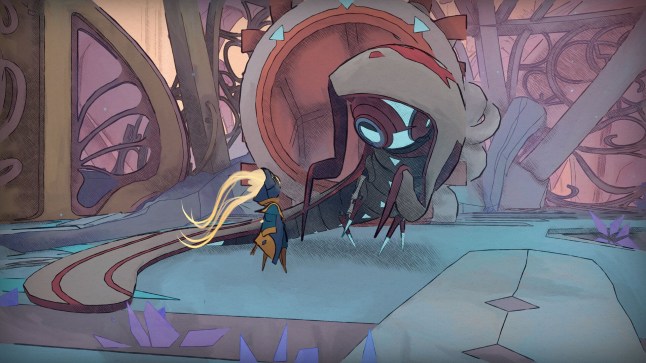


One of the first big indie releases of the year is a new Soulslike Metroidvania that attempts to mimic the success of Hollow Knight, but with robots instead of bugs.
It’s mid-January now and this is the first new Metroidvania we’ve played this year. We very much doubt that it’s going to be the last. The sub-genre is almost unknown when it comes to triple-A games, but it’s become such a mainstay of indie developers that it’s hard to understand how the general public’s appetite for them hasn’t long ago been sated.
Not that we don’t enjoy the games, but it is a shame that despite dozens upon dozens of Metroidvanias being released every year the idea has seen very little innovation or evolution, almost since its inception. The closest it’s come recently is mixing in elements from Soulslikes, as exemplified by last year’s Hollow Knight: Silksong.
For all its qualities, Silksong wasn’t very original either, but it was perfectly crafted and under different conditions might have been seen as drawing a line under the whole concept. But here we are, just a few months later, with another game of very similar quality, but sci-fi instead of fantasy.
MIO is not a game that likes to overexplain itself – even its tutorial doesn’t tell you what the controls are – but what you realise within the first few hours is that you’re a miniature robot in a giant spaceship, that has deteriorated to such a point that it’s barely keeping itself together. Most of the other robots have lost their metal minds and your own memories, of what you used to be, have faded away.
The set-up is a bit too oblique, but it’s artfully presented and the visuals throughout are gorgeous. Things start off fairly mundane, with lots of grey looking sci-fi rooms, but the more you explore the more colour comes into the game and you’re able to appreciate the watercolour style art to its fullest. It’s a gorgeous game and in that sense at least, superior to Silksong.
Expert, exclusive gaming analysis
Sign up to the GameCentral newsletter for a unique take on the week in gaming, alongside the latest reviews and more. Delivered to your inbox every Saturday morning.
In terms of difficulty the two games are, for better and worse, essentially equal. MIO is a brutally hard game, in terms of both platforming and combat, and comes complete with all the Soulslike trappings of collecting lost resources when you die and having to walk just a bit too far, at least in some cases, to retry an unsuccessful boss battle.
Platforming is a particular emphasis in MIO, with the fluid movement and elegant double jumps reminiscent of Ori And The Blind Forest mixed with Super Meat Boy. It looks and feels great, jumping around the 2.5D environments, and there are satisfyingly well hidden secrets all around, but inevitability it becomes toe-curlingly difficult before long – even if there is a later ability that allows you to negate some of it.
However, there is an interesting system of perks that makes both platforming and combat easier, comparatively speaking, with a huge range of collectible upgrades that work well as rewards for careful exploration and do everything from improving your jumping distance to increasing defence or attack. You never have the capacity to use every upgrade you want though and frustratingly this even includes making choices between displaying your health status or enemies’.
In some situations, particular upgrades are needed to progress – or at least it seemed that way to us, the game never acknowledges it one way or another – but there’s also the more standard range of mandatory new abilities to collect, which open up whole new areas. Alas, most of these are straight out of the Metroid playbook, including a grapple hook and a spider ball analogue.

We’re now 15 years out from Dark Souls and the idea of punishingly hard video games is a well established norm, but it’s a difficult balancing act to get right and in almost every instance MIO misses the mark. The dodge-heavy combat gets it just about right, assuming you’re happy to sit back and learn all the tells of each enemy’s attack, but the platforming and punishment for failure feel a step too far.
The fact that there are dozens of upgrades is interesting, but the harsh restrictions put on their use is never not frustrating. Even the storytelling asks too much of players, making it hard to discern exactly what’s going on and, more importantly, making character motivations and goals difficult to understand or care about.
And while backtracking is an intrinsic part of the Metroidvania experience there’s rarely any sense of triumphantly returning to an older location with new abilities, to help you explore further. More likely you’ll return to the same areas again and again simply because you’re lost or carrying out a fetch quest.
In strict gameplay terms this is close to an equal of Hollow Knight and its sequel, but we didn’t enjoy it nearly as much, even while we were being impressed by the visuals. In that sense it’s a fascinating example of how even very small differences in approach can make all the difference between a modern classic and, in the case of MIO, an enjoyable but frustratingly flawed also-ran.
MIO: Memories In Orbit review summary
In Short: A strikingly beautiful, sci-fi alternative to Hollow Knight: Silksong, but one which is consistently off the mark when it comes to the balance between difficulty and frustration.
Pros: Amazing visuals and a great, low-key soundtrack. Clever map and platform design, that you can explore multiple ways with the various abilities.
Cons: The platforming and combat gets hugely frustrating after a few hours and the limitations placed on the upgrade system are always irritating. Storytelling leaves too much unsaid and there’s very few original ideas.
Score: 7/10
Formats: PlayStation 5 (reviewed), Nintendo Switch, Xbox Series X/S, Nintendo Switch 2, and PC
Price: £15.99
Publisher: Focus Entertainment
Developer: Douze Dixièmes
Release Date: 20th January 2026
Age Rating: 7

Email gamecentral@metro.co.uk, leave a comment below, follow us on Twitter.
To submit Inbox letters and Reader’s Features more easily, without the need to send an email, just use our Submit Stuff page here.
For more stories like this, check our Gaming page.